Private Estate vs. Hotel: What Works Better for Executive Offsites in 2026?
Executive off-sites are not team-building exercises. They’re moments of truth—where priorities are challenged, direction is clarified, and decisions are made that ripple across the company. In 2026, leaders are far more selective about where those conversations happen. And the biggest question they’re asking isn’t about amenities or star ratings. It’s this:
Should our executive offsite be held in a hotel or a private estate?
The answer is increasingly evident.
Why Hotels Became the Default—and Why They’re Losing Ground
Hotels were once the obvious choice for executive off-sites. They offered convenience, predictability, and built-in services. But what made them easy also made them limiting.
Executives planning off-sites today are noticing the same friction points again and again:
The constant background noise of other guests, shared lobbies and hallways, and rigid meeting rooms designed for conferences rather than conversations. Even in luxury hotels, leaders often feel like visitors rather than owners of the space.
That subtle dynamic matters. When executives don’t fully control the environment, discussions tend to stay cautious. Conversations become scheduled instead of organic. Breakthrough moments are interrupted by logistics.
In a hotel, the offsite adapts to the venue.
The Rise of the Private Estate Offsite
Private estates flip that relationship.
Instead of fitting conversations into pre-designed meeting rooms, the environment bends around the group. The space becomes quieter. Movement becomes natural. Privacy is no longer a request—it’s the baseline.
In 2026, executive teams are choosing private estates because they offer something hotels can’t replicate: psychological safety through complete ownership of the space.
There are no overlapping events. No neighboring meetings. No staff rotating through rooms every hour. Just a single group, in one place, with the freedom to think and speak without filters.
What Executives Actually Need From an Offsite Space
At the executive level, the requirements are surprisingly simple—and very specific.
Leaders need:
Time that isn’t rushed,
Space that isn’t performative,
And an environment that allows conversations to unfold naturally.
Private estates support this by design. Strategy sessions don’t feel like presentations. Meals don’t think like breaks from work—they become part of the work. Silence, nature, and distance from daily routines help leaders move beyond surface-level updates into real alignment.
Hotels, by contrast, are optimized for efficiency and scale. Executive off-sites are optimized for depth.
Where Hotels Still Make Sense—and Where They Don’t
Hotels still work well for:
large-scale conferences,
sales kickoffs,
Or events where structure and repetition are required.
But for executive offsites—especially for leadership teams, founders, or boards—the hotel format often creates friction rather than flow. When every conversation must fit into a time slot, and every room looks the same, the environment subtly discourages vulnerability and long-form thinking.
That’s why many executive teams now treat hotels as operational venues rather than strategic ones.
Why Casa Campo Homestead Works Better for Executive Offsites in 2026
Casa Campo Homestead represents the kind of private estate executive teams are actively seeking in 2026.
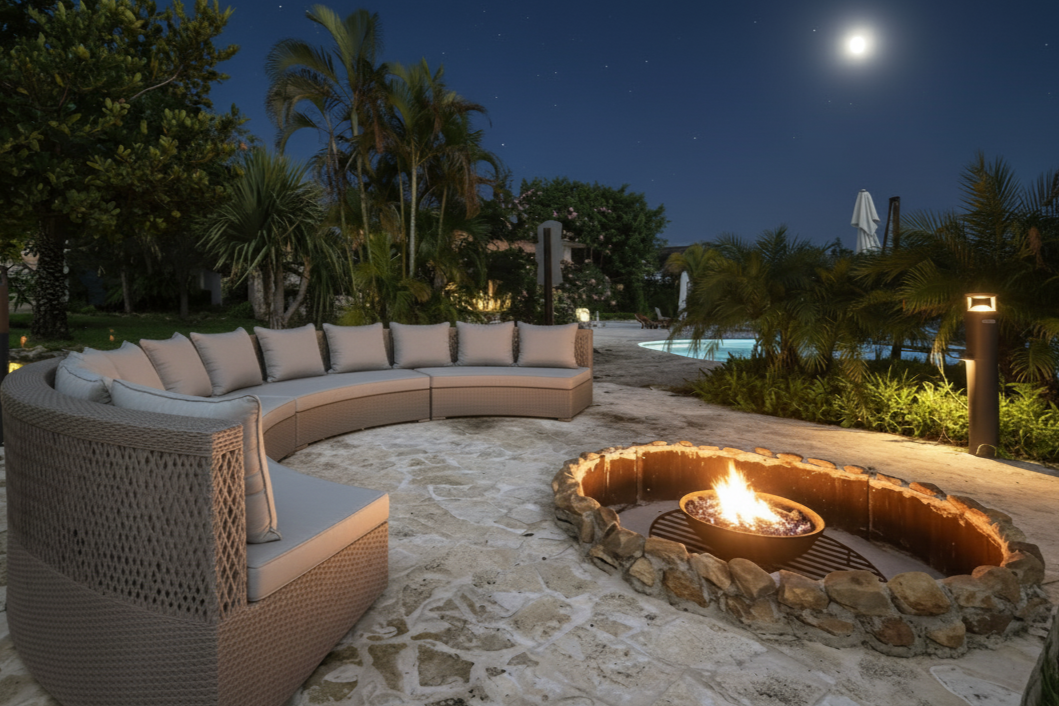
Set on a secluded avocado estate just south of Miami, Casa Campo is designed around focus, privacy, and natural flow. It’s not a hotel trying to accommodate off-sites—it’s a private environment where off-sites happen naturally.
For executive teams, that translates into:
complete buyout privacy,
Spaces that support both structured discussions and informal conversations,
And a setting that immediately slows the pace without sacrificing intention.
There’s no sense of being “on display.” Leaders can move from a strategy session to a shared meal to a quiet walk without ever leaving the property—or breaking the rhythm of the day.
That continuity is where trust deepens and decisions sharpen.
The Difference You Can Feel in the Room
The most telling difference between hotels and private estates isn’t logistical—it’s emotional.
In hotels, conversations often pause when time is up.
In private estates, conversations end when they’re finished.
Executives sit longer. They listen more carefully. They’re less guarded. The absence of outside noise creates space for honesty, disagreement, and clarity—things no agenda can force.
That’s why teams leave private estate off-sites not just aligned, but grounded.
The New Standard for Executive Offsites
In 2026, executive off-sites aren’t about where it’s easiest to book. They’re about where the right conversations can actually happen.
Hotels will always have a place. But for leaders who want depth over efficiency and clarity over convenience, private estates are becoming the standard.
Because when the environment supports presence, leadership work gets done—not scheduled.